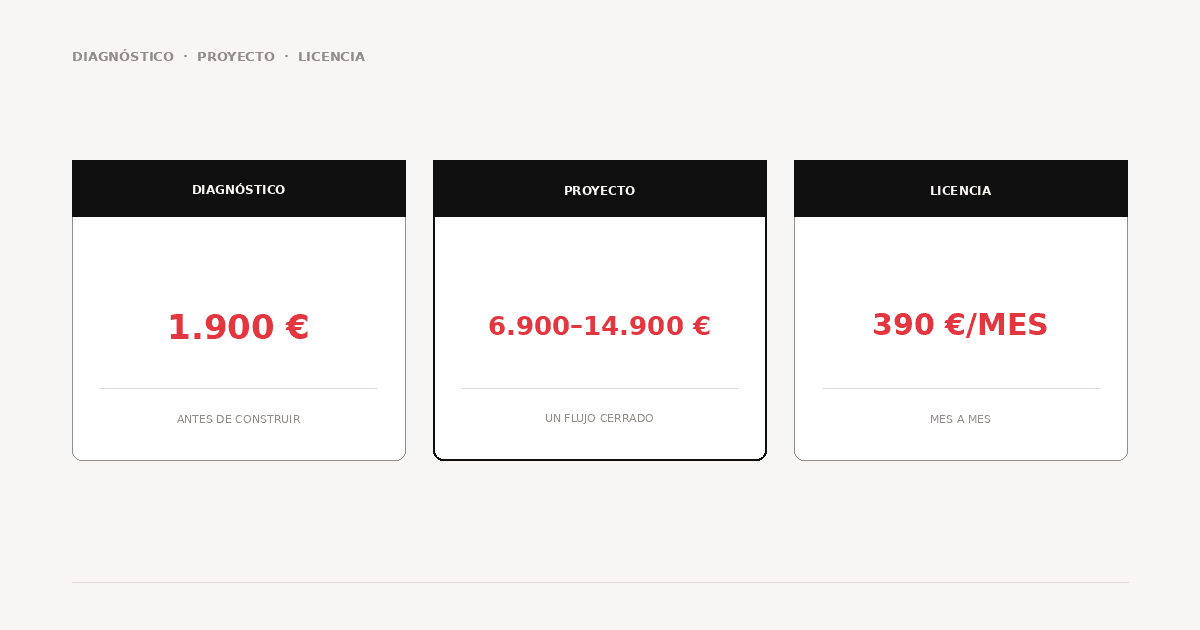
In Spain, as of September 2026, Wallion publishes three figures: a €1,900 Diagnosis (credited if you proceed), a €6,900–14,900 build only for one internal flow / one internal tool, and a licence from €390/month. That is not “any custom software”: apps, MVPs and staffing get a written fixed price, outside that band. If someone anchors an external-facing product on €6,900–14,900, they are comparing the wrong commission.
This page is the tariff and the comparison frame — not a case study with invented clients. Offer: /en/pricing. Hub: /en/software.
2026 market versus Wallion (Option D)
Tables usually arrive with “indicative” PDFs, retainers and agency bands that, for a mid custom-software engagement in Spain, often sit roughly between €15,000 and €80,000 (sometimes more) when scope is fuzzy, project-management layers stack up and the buyer carries cut risk. We do not name other studios here — only an anonymous 2026 market summary next to what Wallion publishes.
| Item | 2026 market (anonymous ranges) | Wallion (Option D) |
|---|---|---|
| Entry / discovery | Kickoff or discovery often several thousand; sometimes “free” then hours | €1,900 Diagnosis fixed; credited against the build if you proceed |
| One bounded internal flow | Project or retainer: frequently €15–40k (or more) when the PDF lacks “in / out” | €6,900–14,900 fixed — only one internal tool / one flow, 4–8 weeks; includes three months of licence |
| App, MVP, broad programme | Typical market bands €30–80k+ when many hands, brand and open scope pile on | Written fixed price (different figure; same scope + number + date model) |
| Month to month | Retainer, tickets or “then we iterate” = hours | Licence from €390/month if we keep what we built |
| Who carries scope risk | Often the buyer, if the PDF is fuzzy | Scope written day one; if it moves, the price reopens — it does not hide inside more hours |
The useful question is not “who is cheapest in month one?”. It is: who carries the risk if scope moves, and is it written down? Fixed vs hourly as a buying criterion lives in fixed price or hourly. This page is the Option D tariff and comparison; that one is the decision frame.
What sits in each Wallion figure (Option D)
Diagnosis — €1,900
In: one flow (not “the whole company”); an audit of how it lives today (spreadsheet, email, three tools that do not talk); a clickable prototype; a written fixed build quote; about two calendar weeks per the published offer.
Out: a six-month transformation deck; staffing dressed up as diagnosis; building the full product inside the €1,900; website promises of ownership or escrow.
If you do not proceed, you keep the scope and the prototype — not an empty PDF. If you proceed, the Diagnosis is credited against the build. Detail: /en/pricing.
Build — €6,900–14,900 (one flow)
That band is one internal tool: one flow, after Diagnosis. Table patterns (no invented clients): quotes, tracking, planning or reports the team uses every day; replacing the spreadsheet that stops month-end on day 28.
In: the flow written in the Diagnosis; build deployed on the published rhythm (4–8 weeks for a bounded flow); three months of licence included per the offer; integrations the Diagnosis scoped as part of that flow.
Out: an app with external users / a product MVP; “digitise the company” or three flows under one number; staffing or backlog reinforcement; brand redesign or a second product “while we’re at it”; mid-build scope moves (price reopens).
If the pain is a product for outsiders: /en/software/mvp. If it is the internal flow: /en/software/internal-tools.
Licence — from €390/month
Hosting, security, regulatory and API changes, a ceiling of small-change hours, business-hours support — as published on the offer. The build is the slice; operating is the month. Code ownership and any escrow are set in the project contract, not on this website. More context: who owns the code.
Apps, MVPs, staffing
Same model (scope + number + date), different figure. Not the €6,900–14,900 band. Ask for a written fixed after Diagnosis.
Why the market talks about €15–80k
A high range is not “theft” by default. It usually reflects:
- Open scope — “a commercial app” with no in/out sentence. Whoever signed absorbs it or reopens quietly.
- Agency layers — account, PM, design, several profiles billing kickoff and “alignment”.
- Hours labelled as fixed — “then we iterate” = a counter. Cut risk is yours.
- Several flows or an external product — users, onboarding, devices: not one internal flow.
- Endless discovery — months of workshops before a number that is still indicative.
- Comparing different products — a €40k indicative PDF versus a one-flow fixed quote do not compete.
Wallion does not invent third-party tariffs. It publishes Option D and leaves scope risk written down. Model criterion: fixed price or hourly. Ownership and escrow: contract only — see who owns the code. Code ownership and any escrow are set in the project contract, not on this website.
12- and 36-month TCO example (illustrative, Option D)
This is not a case study or a real client. It is arithmetic with the published figures, so you can compare models at the table. Assumption: one internal flow at the mid-point of the build band (€10,900), €1,900 Diagnosis credited on proceed (so entry into the build is the €10,900 after credit), and a €390/month licence after the three months included in the build.
| Horizon | What you add (example) | Order of magnitude |
|---|---|---|
| Year 1 | Build €10,900 (Diagnosis credited) + 9 months of licence × €390 | ≈ €14,410 |
| Years 1–3 | Year 1 + 24 further months of licence × €390 | ≈ €23,770 |
If the Diagnosis is not credited (you do not proceed), you have paid €1,900 for scope and a prototype — and you have not burned the build band on the wrong problem. If someone puts a €2,500–4,000/month agency retainer on the table with no “done” sentence, year three usually overtakes this example even when month one “looked cheap”. Always label the TCO as an Option D example, not a promise for a specific project: the closed number comes from Diagnosis.
What spikes the price (six factors)
- Fuzzy scope — without “this is in / this is out” there is no reliable fixed price; only a hope with a figure.
- Several flows under one number — three processes ≠ one internal tool.
- External users / MVP — another band; ask for a written fixed; do not anchor €6,900–14,900.
- Unbounded integrations — “every API” does not fit one flow; Diagnosis lists them.
- Mid-build scope change — price reopens; it does not hide inside hours.
- Staffing mixed into a project — hands on a live backlog is another commission; do not fold it into the one-flow band.
Custom vs SaaS vs low-code (decision rule)
- SaaS wins when the process fits the standard product and fighting the 5% that does not fit costs more than the monthly toll. Configure; do not build.
- Low-code / no-code wins to validate or for a temporary patch without critical IP. The ceiling arrives when the flow does not fit and the partner bills “custom” with no cut written on day one.
- Custom (Wallion) wins when one flow fits on a page, you want a “done” date and scope risk written down. Start with Diagnosis.
Landings: hub /en/software · internal tools · MVP · AI automation.
Barcelona, stack and names we are not
Wallion is a Barcelona custom-software studio; it works with SMEs in the city, the metro area and the rest of Spain. Usual delivery stack: TypeScript / React / Node and managed cloud — one-path discipline so price and date can close. Geo: /en/software/barcelona.
Wallion is not Wallion Mobility, Glowapp or Nummo (other products or lines). Nor is it Wialon (fleet GPS) or Wallien. If search leads you to those names, that is not this service.
How to ask for a budget that does not move (checklist)
- Write on one page what is in and what is out before you ask for a figure.
- Say whether the day-40 user is internal or external (flow vs MVP/app).
- Ask for number + date + scope sentence in the same document — not a lone “indicative” range.
- Ask what happens if scope moves: does the price reopen, or do hours appear?
- Separate build from month to month (licence / retainer / tickets).
- Ask for the fixed quote in writing after a diagnosis with a prototype — not “we start and see”.
FAQ
How much does custom software cost in Spain with Wallion in 2026?
Diagnosis €1,900 (credited if you proceed). Build €6,900–14,900 for one internal tool / one flow. Licence from €390/month. Apps, MVPs and staffing: written fixed price. Detail: /en/pricing.
Is the €1,900 Diagnosis lost if we do not proceed?
If you proceed, it is credited against the build. If not, you have paid for written scope, a prototype and a proposed fixed build — not an empty deck.
Does the €6,900–14,900 band cover an MVP or an app?
No. That band is one internal tool / one flow after Diagnosis. MVP and apps: /en/software/mvp — written fixed, different figure.
Why does the market cite €15–80k while Wallion publishes another band?
Because open scope, agency layers and external products are often mixed in. Option D isolates one flow with a closed number. Compare models, not PDFs without a scope sentence: fixed price or hourly.
Do we own the code? Is there escrow?
Code ownership and any escrow are set in the project contract, not on this website. Context: who owns the code.
What does the licence from €390/month include?
Hosting, security, regulatory and API changes, a ceiling of small changes and business-hours support, per the offer. Large changes get a closed quote — not an endless renegotiation.
Is Wallion Mobility, Glowapp, Nummo, Wialon or Wallien?
No. Here Wallion is the custom-software studio. Those other names are different products, brands or services; do not confuse them in search. Geo: /en/software/barcelona.
How do we get a fixed price in 48 hours?
First a 30-minute conversation to see whether one flow fits. The next step is to ask for a written fixed price (48 h) (target reply around two business days when scope fits on a page). That request form is in product draft: treat it as a next step / copy, not as a form already live in production.
Dual CTA
Primary — 30 minutes. If the blocker is which band to compare, whether one flow fits, or whether SaaS is enough: book a call.
Secondary — written fixed price. When you can already write in/out on one page, the next step is to ask for a written fixed price (48 h). That form flow is in draft (PR93): use the call or site contact as a bridge until the form ships; we do not claim the form is live today.
Packages: /en/pricing. Hub: /en/software. Updated September 2026.